Table of Contents
ADAS calibration has become one of the most consequential parts of the repair process, and one of the most misunderstood. Shops that are just getting started are often surprised by how much is already required of them, and how much revenue they've been leaving on the table.
The good news is that getting started doesn't require a massive equipment investment upfront. It starts with understanding the fundamentals. We pulled the key takeaways from our ADAS 101 webinar, hosted by Joel Adcock, Director of Strategic Partnerships at Revv, to give everyone in your repair shop a practical place to start.
1. ADAS is already in your shop
First and foremost, ADAS isn’t a luxury vehicle problem or a future consideration. It's already in your shop.
According to research, a majority of vehicles entering shops today are equipped with ADAS systems that may require calibration, and that number continues to climb as newer vehicles make up a growing share of repair volume. Ten out of 14 major ADAS features now exceed 50% market penetration on new vehicles.
Liability exposure is rising alongside it. Back in 2024 alone, 61 cases were moving through litigation specifically tied to ADAS functionality being missed or not performed correctly during a repair.
If you’re treating ADAS calibration as a specialty service, you’re already behind.
2. The biggest mistake: leading with equipment
Once you realize how much ADAS work is already coming through your door, the next instinct is usually: I need to get the right equipment. That instinct isn't wrong. But equipment isn't your first step.
The most common entry-point mistake is jumping straight to a capital investment without first building your ADAS calibration workflow. You buy the equipment, hand it to a tech, and quickly realize you have no consistent process for identifying calibration requirements during blueprinting, no documentation standards, and no clear handoff between the estimator and the bay. Missed calibrations and denied claims follow as a result.
As Joel put it: "ADAS is a workflow. It's not just equipment. It's not just one piece of training. It's a process."
Start by mapping where ADAS requirements are falling through the cracks in your current process. Who's pulling OEM procedures at blueprinting? Who's making sure calibrations make it onto the repair order before the insurance estimate goes out? Get those answers documented first. Then think about the equipment.
3. Pre-scans are non-negotiable, and timing matters
Every vehicle that comes through your shop needs a pre-scan. And that scan needs to happen at drop-off, before you begin work on the vehicle.
Pre-scans serve three critical purposes at the start of a repair:
- Identify diagnostic trouble codes (DTCs) that may point to required calibrations
- Reveal hidden faults in systems that may appear to be functioning normally
- Establish baseline documentation that supports every step that follows in the repair file
A useful way to think about it: a sensor can be electrically operational but pointed in the wrong direction. No warning lights, no codes, but the system isn’t functioning correctly. Without a pre-scan, you can miss this fault entirely.
Waiting until the vehicle is already torn down also compromises your documentation, too. Do your scan first.
4. "No lights, no codes, no calibrations" will cost you
This is one of the most expensive assumptions in the industry. Many ADAS calibration needs don't generate visible warning lights. They don't always trigger codes on a scan, either.
Most calibration triggers come from OEM research, not from what a pre-scan shows on its own. That means after reviewing your scan results, the next step is pulling the OEM procedures for that vehicle based on the repairs being performed.
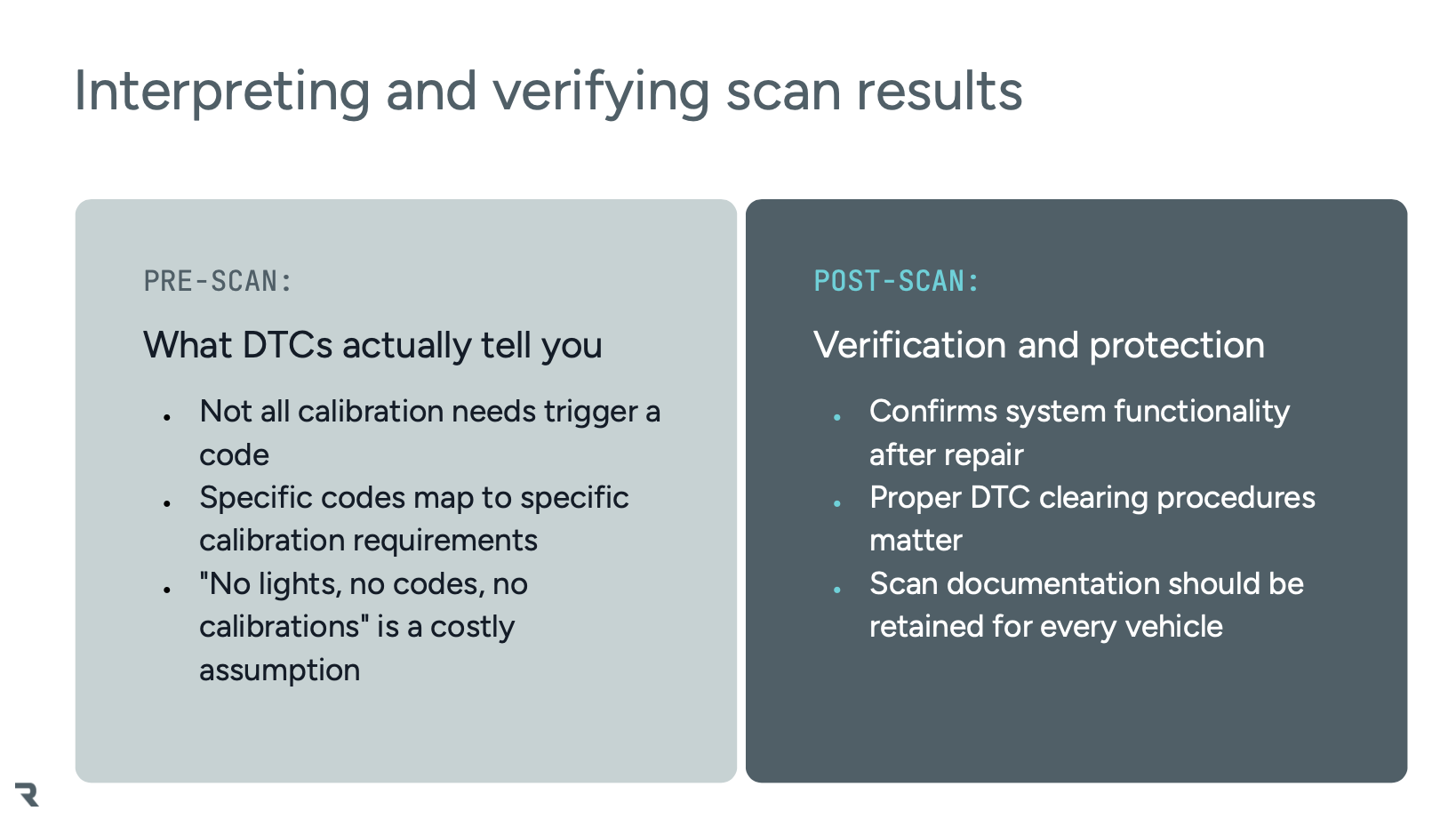
The smarter default is to assume every vehicle may need a calibration, and let your OEM research tell you otherwise. If you're working on a front bumper and the vehicle has a forward-facing radar, there's almost certainly a calibration required, whether or not the scan showed a code.
5. Documentation is what gets you paid
You do the work. And you deserve to be paid for it in full. Unfortunately, 77% of shops experience pushback from insurance on ADAS calibration charges. The shops that consistently get reimbursed? They document calibrations properly.
"If we don't document, as far as the insurance companies are concerned, it didn't exist or didn't happen." – Joel Adcock
The most common reasons claims get denied or reduced come down to a few recurring issues:
- Lump-sum calibration charges with no breakdown
- No OEM procedure attached to the estimate
- No proof that the calibration was actually completed
Adjusters need to see each calibration listed as its own line item. They need to see that the work was manufacturer-required for that specific vehicle and repair type. And they also need proof that the calibration was completed, including:
- Screenshots of a completed calibration
- Photos of your setup
- Scan reports retained for every vehicle
What a complete calibration file actually looks like
A complete calibration file is your best defense against claim denials, liability exposure, and rework. Here's what it needs to include:
- A detailed line-item breakdown with one line per calibration
- Pre-scan and post-scan reports
- OEM procedure printouts or links tied to the specific VIN
- A calibration certificate showing successful completion
- A completion verification
One more thing: don't wait until the vehicle is ready for pickup to send documentation to the insurer. Get your calibration line items into the estimate early, while the car is still in the shop. It's a much easier conversation at that point than it is after delivery.
6. ADAS is a shop-wide process, not just a technician problem
ADAS doesn't fail because technicians can't do the work. It fails because the rest of the shop isn't in on it.
"This should be something from a culture standpoint that your team is keenly aware of, from the front of the house all the way back through paint refinishing to detail to your body technicians. Everybody should be on board on what the process is, what the workflow is, what the overarching focus is when it comes to ADAS, vehicle safety, customer safety, and from an opportunity to drive additional revenue." – Joel Adcock
A smooth handoff matters, too! If the estimator doesn't catch a calibration requirement at intake, the technician never sees it. If the technician performs the calibration correctly but nobody documents it, the shop doesn't get paid. If the service advisor doesn't understand what a calibration is, they can't explain the charge to the customer at pickup.
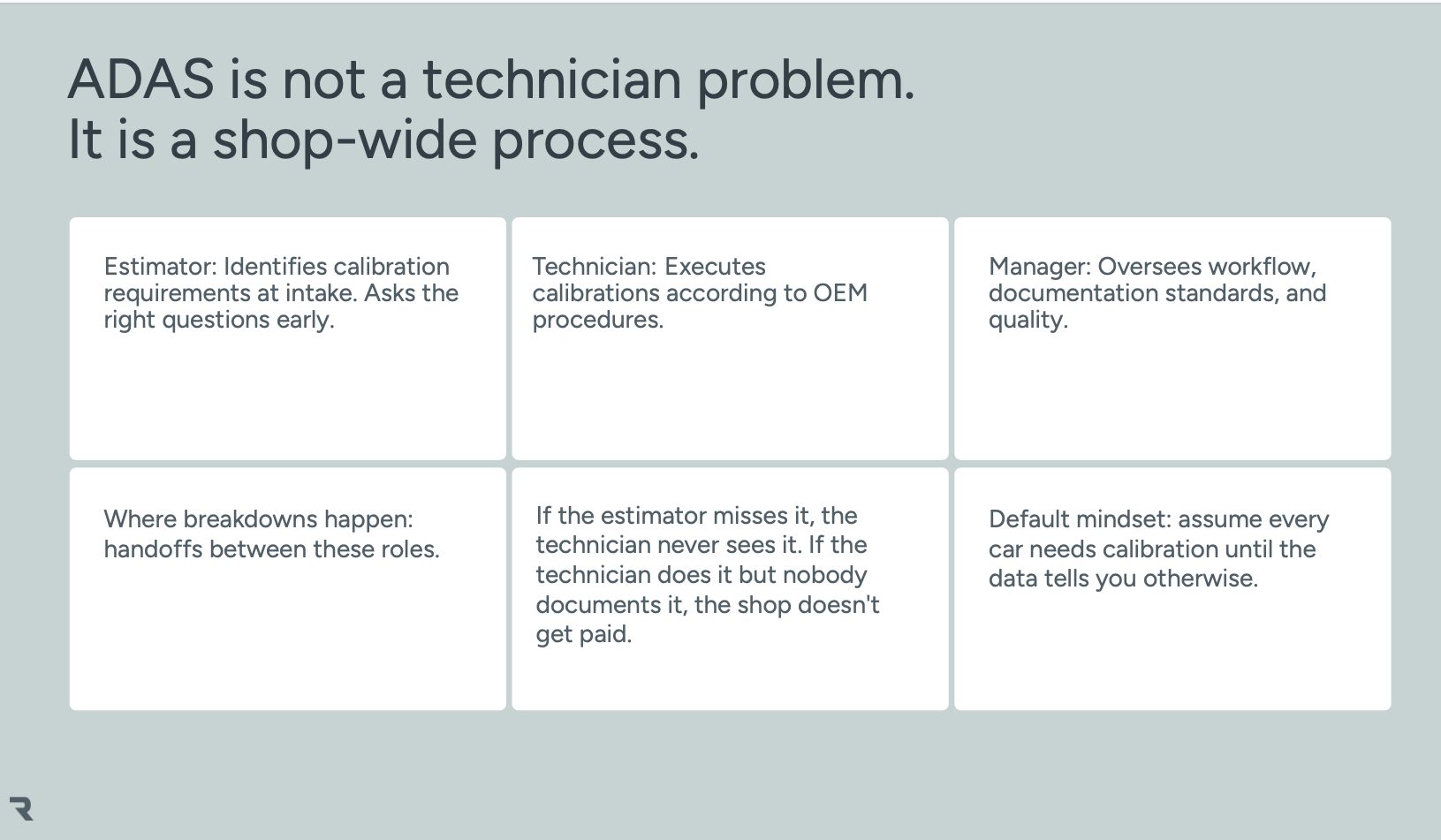
Every role in your shop has a part in this. Estimators need to be identifying calibration requirements early and building them into the repair order. Technicians need to be executing to OEM procedures and capturing proof of completion. Managers need to own the workflow and documentation standards across every job.
If your ADAS workflow depends on one technician's memory, you don't have a process. Cross-train, build SOPs, and make it repeatable across every vehicle that comes through the door.
7. Four questions to answer before investing in equipment
There's real momentum right now around bringing ADAS in-house. Our research shows that 86% of shops already perform some calibrations in-house. But only 21% report having a fully optimized process. Most shops are somewhere in between, doing some work but leaving a significant amount of revenue on the table.
Before committing to equipment, answer these four questions honestly:
- Volume: Do you have enough calibration work to justify the investment? Look at what you've spent on sublet over the past 90 days. If the numbers don't support the capital expense, subletting remains a smart path.
- Space: Can you dedicate a calibration bay that meets OEM specs? You need a level floor within OEM tolerances, appropriate lighting, and enough clear space for proper target positioning. Not every production floor can accommodate this without changes.
- Staff: Do you have technicians ready to train? Hands-on training matters more than classroom hours, and you'll want more than one person cross-trained to avoid creating a single point of failure.
- Capital: Can you absorb the initial investment and the ramp-up period? Equipment typically runs between $25,000 and $75,000 upfront, with average annual ongoing costs of around $18,773.
If you can't answer yes to at least three of these, a sublet or hybrid model may be the smarter starting point.
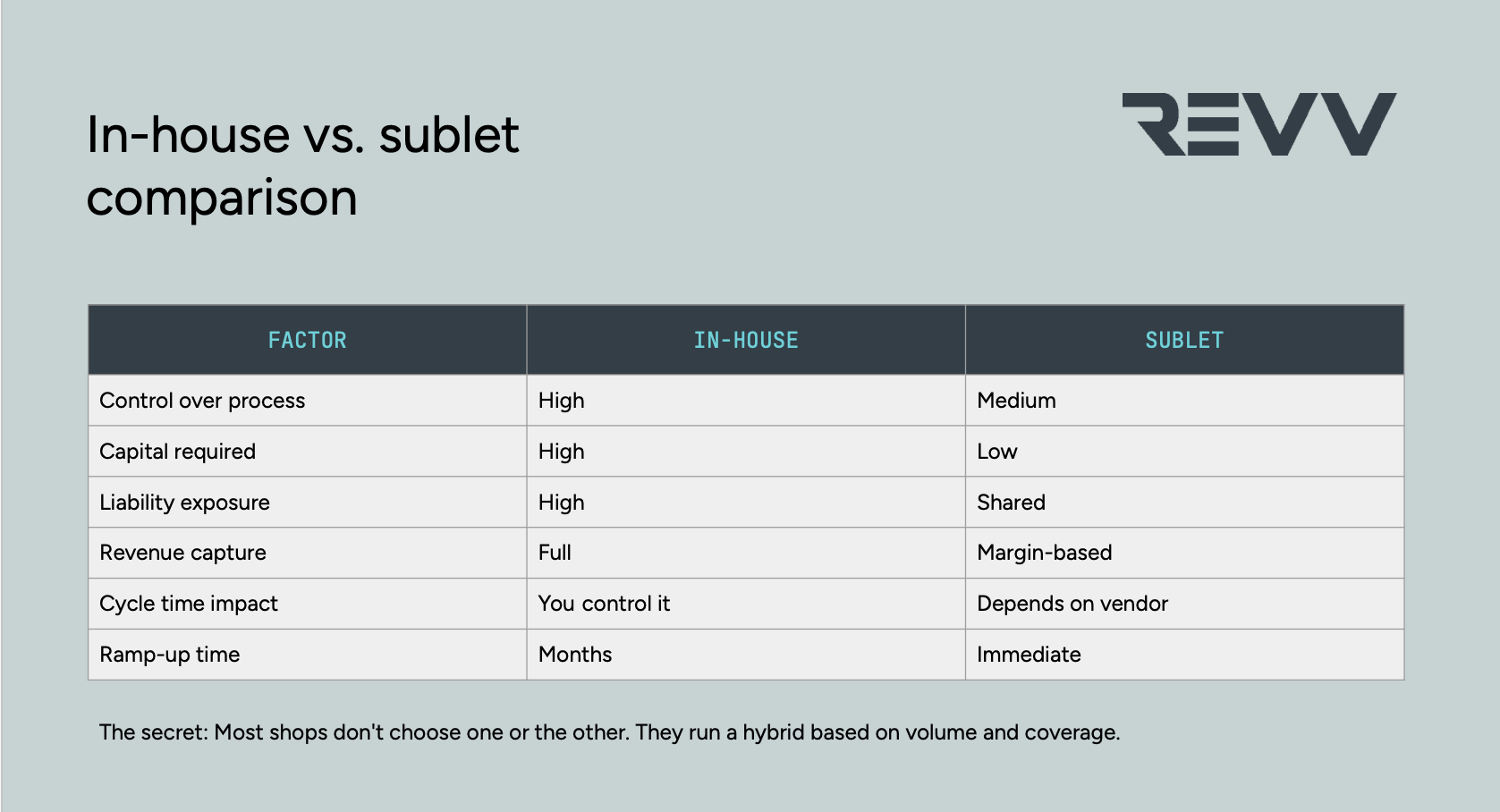
Subletting requires less capital investment, shifts a portion of the liability exposure, and gets you up and running immediately while you build toward more in-house capability.
The opportunity is real, and it's growing
Shops that have built a repeatable ADAS process are averaging $21,509 per month in calibration revenue. ADAS work is projected to grow by 30% over the next two years, and the AEB mandate coming in 2029 will push volume even further.
The shops that will be positioned for that growth are the ones building their process now. Not waiting until the car is already in the bay to think about calibration. Not assuming a clean scan means nothing is required. Not submitting lump-sum charges and hoping insurance doesn’t ask questions.
Watch the full ADAS 101 webinar to get the full picture before you start your ADAS calibration journey.