Table of Contents
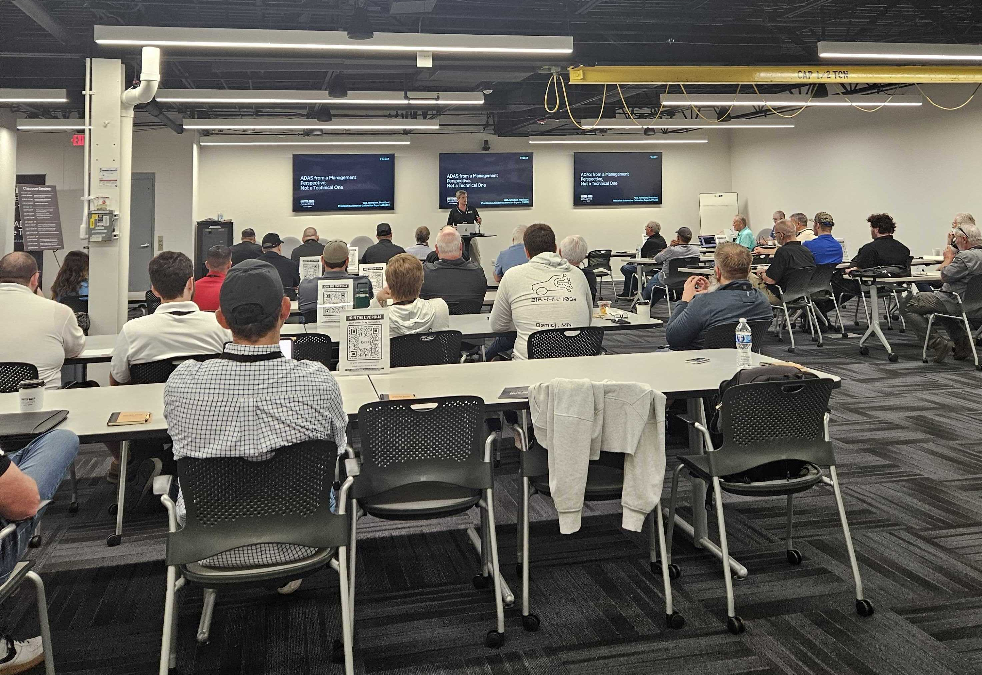
At the recent UAC Leadership Summit, collision repair leaders, ADAS providers, and industry experts came together to talk through the operational side of calibrations.
The consensus was that ADAS has moved from a future concern to a daily operational issue for collision repair shops, shaping everything from estimates and supplements to space planning and reimbursement.
Co-Founder of ADAS Network, Andy Tirado, captured the pace of change during the panel with a quote he attributed to the former CEO of General Electric, Jack Welch: “If the rate of change on the outside of your business is greater than the rate of change on the inside of your business, you're doomed to failure.”
He also added, “If that's true in our space, we've got to be changing and adapting very quickly, because the rate of change on the outside is incredible.”
It’s becoming obvious that ADAS can’t be managed with a wait-and-see approach. Shops need structured workflows, realistic ROI calculations, and documentation strong enough to support reimbursement, reduce insurer friction, and protect the shop when questions come up later.
The warning signs of poor ADAS ownership
Will Johnston, President of PACE, compared the current ADAS moment to the early collision repair network days, when conferences had a collaborative feel and shop leaders shared ideas around common challenges. He sees a similar need for collaboration now as the industry works to keep pace with ADAS.
The discussion quickly turned to what happens when ADAS ownership breaks down. Discussing what warning signs point to an ADAS ownership problem, Dan Shine, Senior Editor at Automotive News, pointed to supplements appearing at the end of the job.
When calibrations are discovered that late, cycle time suffers, insurers are caught off guard, and teams are left justifying work that should have been identified earlier.
“Reflecting back on the ownership side, every car comes through your shop, and as soon as it has some sort of calibration required, your pre-scan and post-scan have to come from the top down. – Dan Shine
Joel Adcock, Revv’s Director of Strategic Partnerships, added similar context from a recent event where shops and insurers were part of the same conversation. Asked what they wanted to see from shops, insurers gave a simple answer: “Just write a good sheet.”
That means getting the documentation out early, helping the insurer understand what needs to be done, and avoiding the surprise of a calibration invoice appearing at the end of the repair.
As Joel explained, much of the friction comes from missing information, delayed documentation, and the fact that insurers are also trying to understand systems they aren’t working on every day.
The ADAS maturity curve: Finding your place on the spectrum
One of the most important ideas from the summit was that bringing ADAS in-house isn’t an all-or-nothing decision. Instead, shops should do a proper assessment to see where they sit on the spectrum based on their volume, space, staff, equipment, and appetite for cost risk.
Will referenced Revv’s ADAS calibration maturity curve, then adapted it through an operator’s lens. Rather than treating the curve as a straight climb from level one to level five, he said each business has to decide what level actually makes sense.
“Rather than seeing it as an evolution everybody goes through from stage one up to five,” Will said, “wherever you decide your business should be on this, there’s really no right or wrong answer.” – Will Johnston
That might mean outsourcing most ADAS work while keeping pre- and post-scans in-house. It might mean handling some programming, initializations, or dynamic procedures through remote support, while still subletting calibrations. Higher-volume shops with the right setup may move further along the curve with dedicated space, a full-time technician, and eventually full-service capability.
The key point isn’t that every shop should chase level five. A low-volume shop may be right to sublet complex work, while a high-volume shop with the right space and technician profile may be leaving money and control on the table by outsourcing too much.
Crunching the numbers: Balancing ROI against space and opportunity costs
The ROI question around ADAS isn’t simply whether calibrations can generate revenue. The harder question is whether a shop can keep the equipment, software, space, and technician time productive enough to make the investment work.
According to Revv’s 2025 ADAS Calibration Industry Benchmark Report, shops report a median initial ADAS equipment investment of $55,494, with ongoing equipment and tooling costs averaging $18,773 annually. The report also found that while 86% of shops perform at least some calibrations in-house, only 21% say their process is fully optimized.
Will used those figures to frame the real test: utilization. With strong repair-planning practices, calibration revenue can represent roughly 6% to 8% on top of collision revenue. He estimated that a shop generally needs about $475,000 in monthly collision revenue to keep a full-time ADAS technician busy enough that idle time doesn’t start eating into margin.
Space adds another layer to that calculation. Will noted that many body shops produce $40 or more per square foot in their production areas, while an ideal calibration environment may require roughly 40 by 60 feet. Many applications can fit into 24 by 36 feet, but that still creates a trade-off.
The staffing element: ADAS calibrations require a different tech profile
Staffing may be the hardest part of ADAS ownership, and Will was clear that a great metal tech or painter isn’t automatically the right fit.
ADAS technicians need a different skill set. They must be comfortable with software, possess diagnostic curiosity, work patiently, and remain cautious of "false positives," where a calibration appears successful even though the setup was incorrect.
Charlie Robertson, President of Collision Career Institute, reinforced that point by drawing a line between knowledge transfer and skills transfer. Passing a multiple-choice test isn’t the same as being able to diagnose, calibrate, validate, and document the work under production pressure.
As Charlie put it, the person who thrives as a “fire-breathing triple-A technician” in a collision repair environment may not be the same person who should own ADAS calibration decisions. ADAS needs people who think through unfamiliar problems, follow OEM procedures, and know when to stop the line because the vehicle isn’t ready for delivery.
Make ADAS calibration decisions earlier in the repair
Another takeaway from the summit was that ADAS calibrations can’t be bolted on at the end. Paul Bostel, Director at Quality Collision Group, described how his team built a phased workflow between its collision and mechanical departments to give each team clear ownership as the repair progresses.
Paul explained that his shop implemented a clear sequence: pre-scanning the vehicle first to identify requirements, then moving it into teardown and blueprinting, then bringing in the mechanical team for their review. Each handoff is deliberate and tracked, so at any point in the repair, everyone in the shop knows where the car is, who has touched it, and what still needs to happen before it moves to the next stage.
In short, ADAS status needs to be visible before the end of the repair. Whether the work is handled in-house or by a calibration partner, teams need to know what is required, where it will be performed, and who owns the next step.
Liability and documentation: Build the file as if it’ll be challenged
At the summit, industry experts also stressed the importance of proper documentation, with Will summarizing his approach simply: “Act like a lawyer is looking over your shoulder.”
He said the best way to protect the shop is documentation that tells the full story of the calibration, from setup through OEM procedure steps, validation, test drive, dash photos, post-scan, and final review.
Andy made a similar point and revealed his team had started “over-documenting” because of how much time can be lost arguing over invoices. By using Revv for scrubbing and backing it up with ALLDATA, he said they eliminated “around 80%” of the billing issues they had been seeing.
Insurance pushback is a common pain point in ADAS work, with Revv’s data showing that 77% of shops experience it. The practical answer? Include detailed line items, scan results, OEM procedures, vehicle-specific requirements, and completion documentation.
The file needs to prove not only that the calibration was performed, but also why it was required and how it was completed.
ADAS ownership starts with a solid process
ADAS can’t be treated as a late-stage add-on anymore. It has to be built into repair planning, staffing, workflow, billing, and documentation from the start.
Shops need to do a detailed assessment of their current capacity, calculate ROI honestly, hire the right technicians to perform the job, and make ADAS visible from intake to final audit.
Revv helps shops identify required calibrations earlier, pull the right OEM procedure information, and generate documentation that is easier for insurers to review and approve.
Book a demo with Revv to see how your team can build a more consistent ADAS workflow, from early identification to the proof needed for reimbursement.