Table of Contents
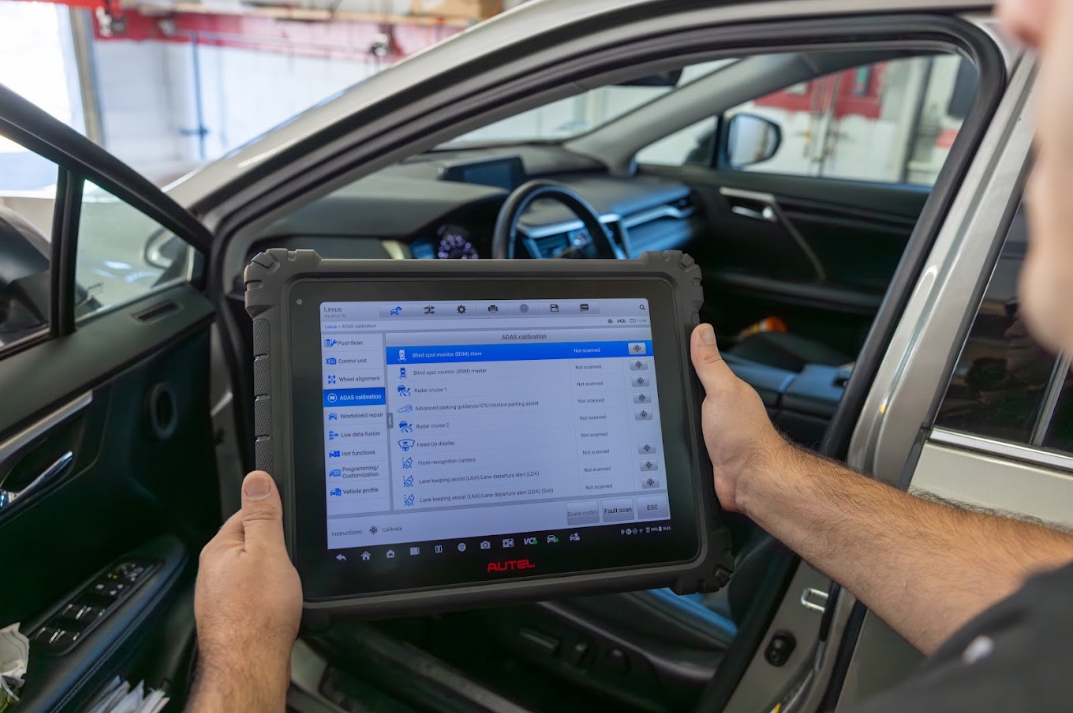
As more vehicles roll into shops for collision repair with forward-facing cameras, radars, blind spot monitoring, surround-view systems, and automatic emergency braking, the difference between “close enough” and "correct" keeps getting smaller for ADAS calibrations.
Shops need to know the right procedure, how to document the work, and how to explain it to insurers and customers. In a recent Revv webinar, Joel Adcock, our Director of Strategic Partnerships, put the issue facing repair shops plainly: “Precision has never mattered more than it does now, and it's going to continue to get more complex, more diverse.”
Let’s break down the difference between static and dynamic calibrations, where shops commonly run into trouble, and how to build a workflow that keeps repairs safe, compliant, and reimbursable.
Why static vs. dynamic calibration matters
ADAS systems depend on sensors that determine where the vehicle is, what’s around it, and how the system should respond. A slightly misaligned camera or a radar sensor mounted at the wrong angle can change how the vehicle detects lanes, vehicles, pedestrians, or obstacles.
Performing correct calibrations helps shops reduce liability exposure, create revenue opportunities, and protect customer safety. But a successful scan report alone doesn’t eliminate liability. Proper calibration means the procedure was required, performed according to OEM specifications, validated, and documented.
ADAS work is becoming harder to separate from everyday repair planning. Shops that correctly identify, perform, document, and invoice calibrations are better positioned to turn that work into a reliable revenue stream.
“As we look into the near future, if we don’t think ADAS is in our shop now, it’s going to be. It’s going to continue to increase, so the opportunity to drive revenue through ADAS calibrations is going to be even more present.” – Joel Adcock
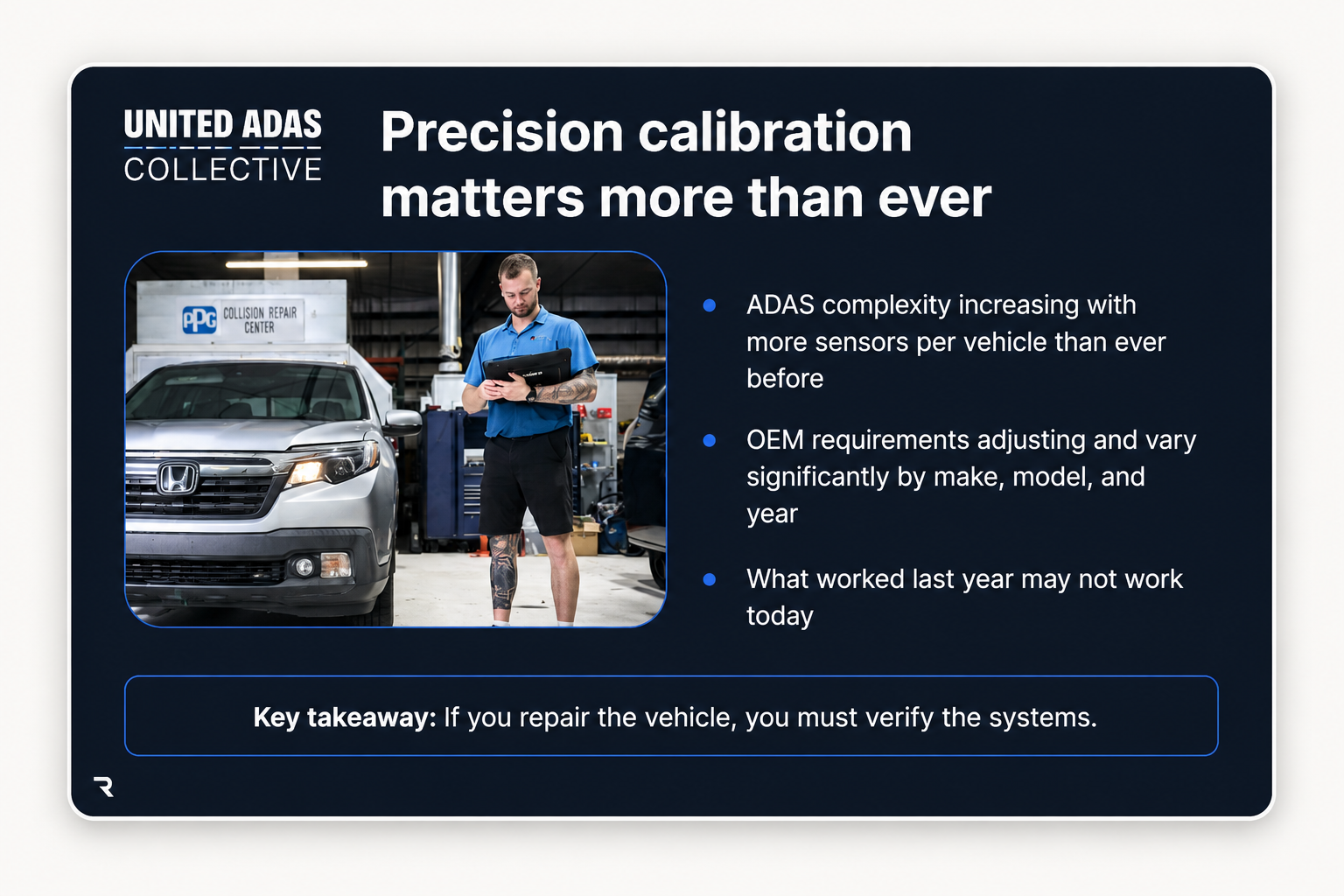
Still, calibration decisions need to be based on OEM requirements, not convenience, assumptions, or what another shop happened to bill.
What is a static calibration?
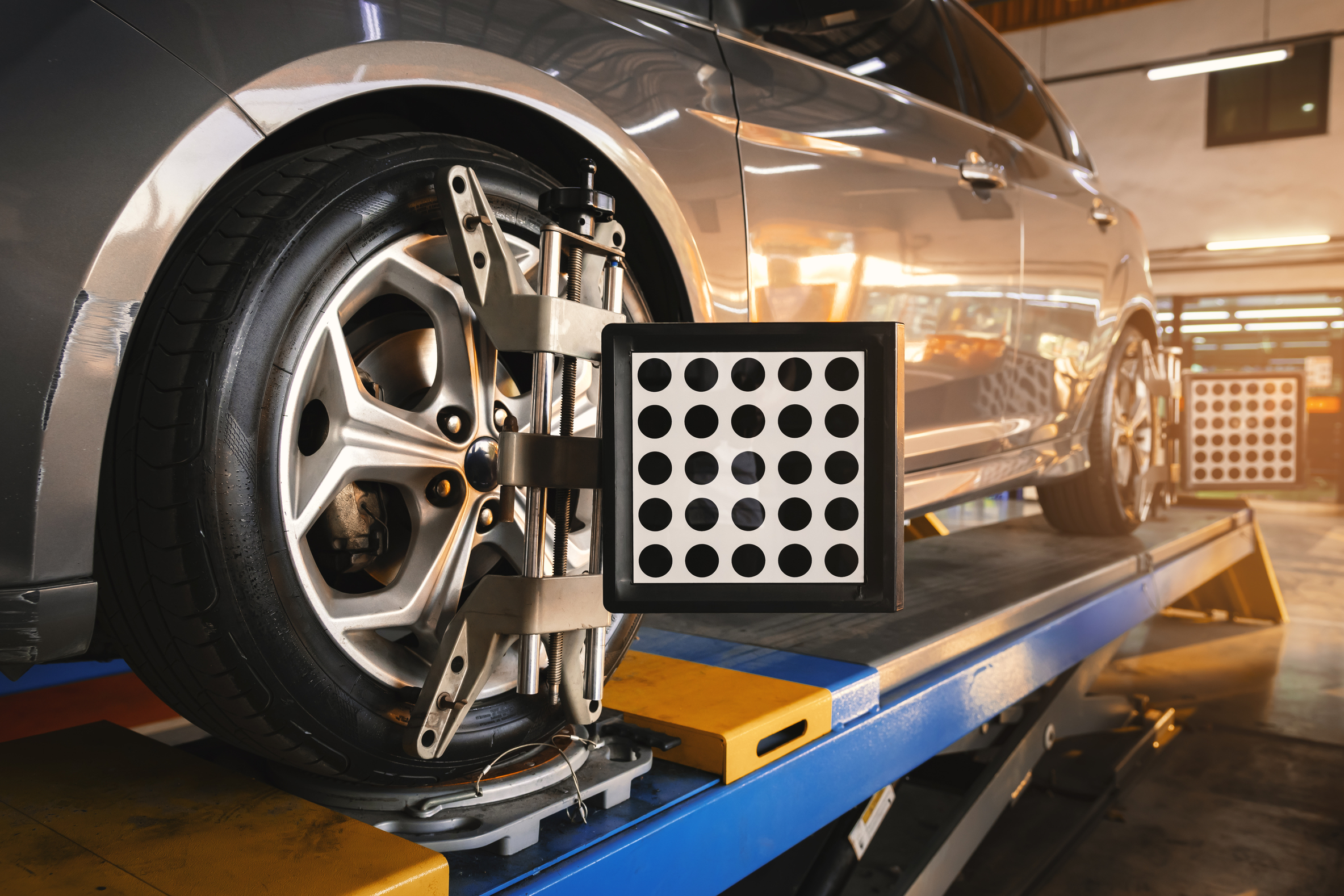
A static calibration is performed while the vehicle is stationary, using an OEM-defined setup in a controlled environment. Depending on the OEM procedure, it may require:
- Targets and stands
- Precise measurements
- Level flooring
- Proper lighting
- Diagnostic equipment
- Exact positioning according to OEM specifications
Static calibrations aren’t meant for a gravel lot, shifting or uneven light, or a target hanging from a fence. The goal is to remove variables that can throw off the calibration. Static calibrations are often required for camera-heavy systems and may depend on vehicle geometry, alignment, ride height, and exact target placement.
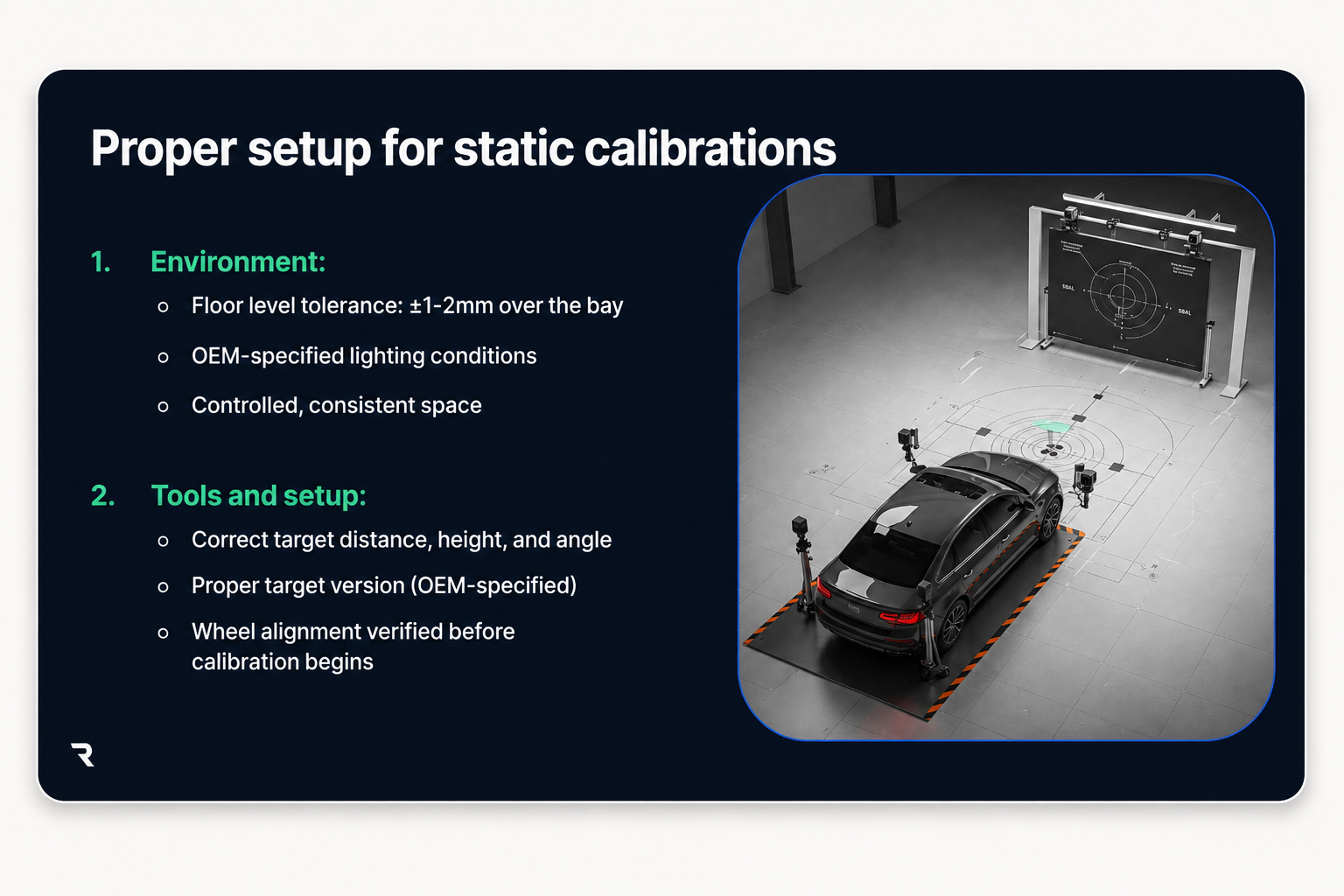
Some static procedures require significant space for targets, stands, and vehicle positioning, which is why calibration planning needs to happen early. Waiting until the end of the repair can create cycle time problems, scheduling delays, and pressure to cut corners.
Common static calibration mistakes to avoid
Static calibration failures often come down to the basics:
- Wrong target
- Poor floor conditions
- Glare
- Rushed setup
- Missing photos
- Measurements adjusted just to produce a successful result
Some shops might manipulate target placements to force a pass, but that’s a big no-no.
“We've seen examples where folks are manipulating those target distances simply to get a successful calibration readout, which can be detrimental to the safety of the vehicle and the vehicle owners themselves.” – Joel Adcock
A scan tool showing a successful calibration doesn’t automatically prove the setup was right. If the target was moved outside the OEM-defined position just to make the procedure pass, the shop may have created more risk than it resolved.
Documentation is another major gap. You may have the final scan report, but no photos of the target setup, no measurements, no proof of environmental conditions, and no clear record of why the calibration was required. Having a proper paper trail in place supports insurance reimbursement and protects your shop if questions come up later. On top of that, it creates consistency across technicians and locations.
What is a dynamic calibration?
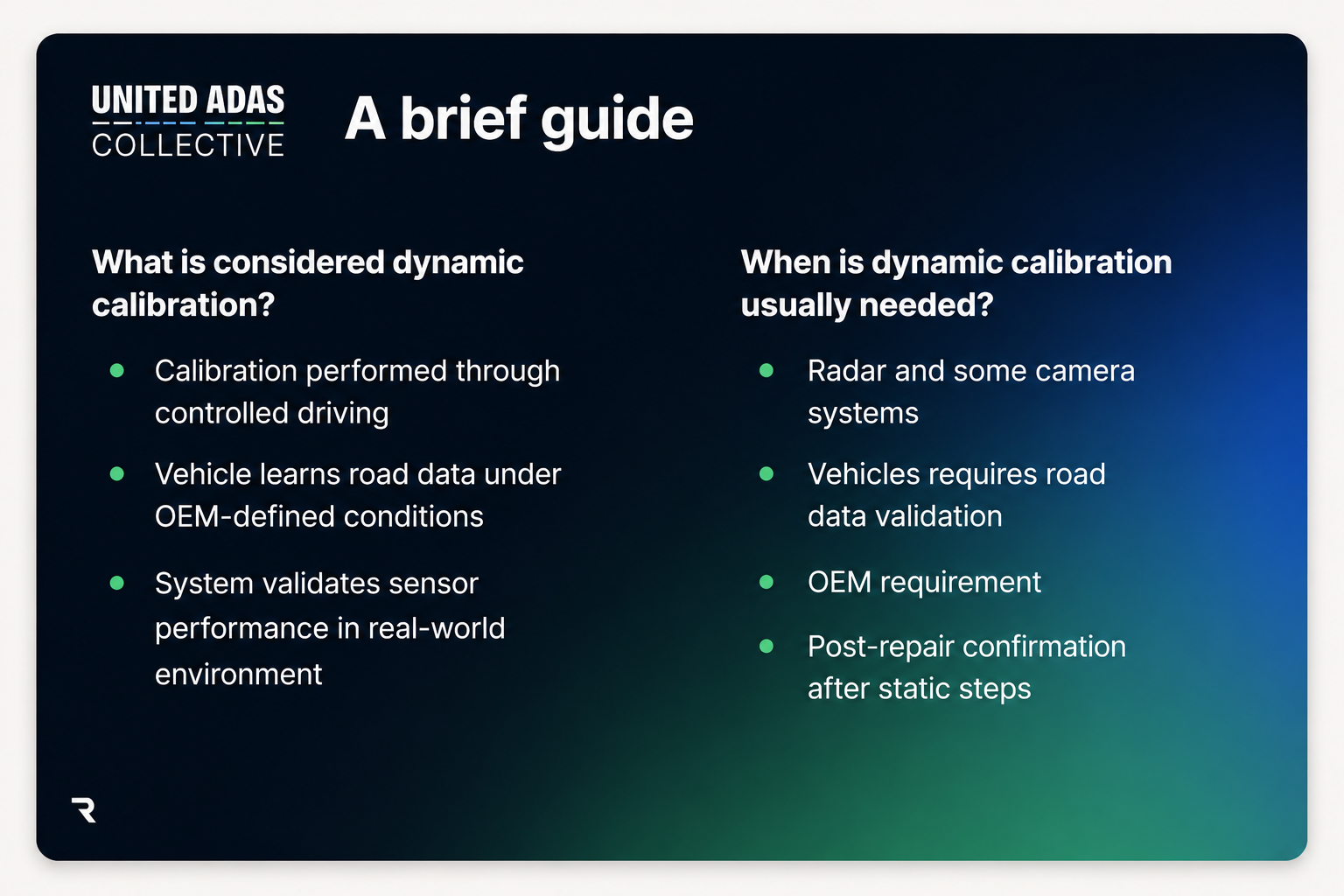
A dynamic calibration is performed while the vehicle is driven under OEM-defined conditions. Rather than relying on a fixed target setup, the vehicle relearns or validates sensor data in real-world driving conditions defined by the OEM.
The OEM may require:
- A certain speed range
- Drive time
- Clear lane markings
- Specific traffic conditions
- An uninterrupted drive cycle
A proper dynamic calibration starts before the drive. The vehicle should be fully repaired, operating properly, and free of active DTCs that would prevent completion. The technician should follow scan tool guidance and OEM instructions, then validate system function.
Common dynamic calibration mistakes to avoid
One of the biggest mistakes with dynamic calibrations is assuming that because the vehicle calibrates during driving, the process can finish after delivery. A dynamic calibration may happen on the road, but it’s still a required repair procedure, not something to leave for the customer.
The vehicle shouldn’t be returned with the hope that the system will complete calibration on the customer’s time. If the OEM requires a dynamic procedure, the shop needs to complete the drive cycle, verify the calibration, and document the result before delivery.
Route documentation is another issue. Shops may complete the drive but fail to record the route, time, road conditions, traffic conditions, or completion notes. That weakens the claim file and makes it harder to defend the process if there’s insurer pushback or a future safety concern.
Dynamic calibration documentation should include:
- The OEM requirement
- Pre- and post-scan results
- Route notes
- Road, weather, and traffic conditions
- Completion status
- Post-calibration confirmation where available
Static and dynamic calibrations aren’t interchangeable
The most important rule? Static and dynamic calibrations aren’t substitutes for one another. Joel put it clearly: “They really aren't interchangeable. Different systems require different approaches. The OEM specifies which method for which sensor.”
This is where shops can get into trouble. A dynamic calibration may seem easier because it avoids setting up targets and measuring the vehicle. A static calibration may seem unnecessary if the dynamic drive cycle passes. But if the OEM-backed documentation requires both, both must be performed.
The reason comes down to what each procedure is designed to do. A static calibration establishes or corrects sensor aim and geometry under controlled conditions. A dynamic calibration validates performance in real-world conditions. In many cases, dynamic calibration assumes the static setup is already correct.
Because modern ADAS often relies on sensor fusion, one misaligned camera or radar can affect more than one system.
How to handle insurer pushback
Pushback is common when both static and dynamic calibration are required. An adjuster may ask why both are needed, or point to another shop that only billed for one.
“As much as we’d like to think insurance companies understand the difference between static and dynamic calibration, I can assure you there are still a lot of adjusters out there, unfortunately, who don’t understand that there is a difference or why we may need to perform both static and dynamic calibrations, potentially for multiple sensors.” – Joel Adcock
That’s why shops need to explain the requirement early and back it up with documentation, such as:
- OEM procedures
- Scan reports
- Setup photos
- Measurements
- Route notes
- Timestamps
- Completion records
You’ve got to educate your customers, too. Most vehicle owners don’t understand static versus dynamic calibration, but they expect their safety systems to work correctly after the repair. Waiting until delivery creates frustration. By then, the customer is ready for the car, the insurer may still be questioning the procedure, and you’re left defending work that should’ve been explained earlier.
A better approach is to bring calibration into the conversation during estimating and repair planning. If the vehicle has ADAS features, explain that your team will research OEM requirements, identify needed calibrations, and document the work to support safety and reimbursement.
Revv helps shops build calibration confidence
Static and dynamic calibration decisions will only become more important as ADAS systems become more complex, OEM requirements evolve, and insurers ask for stronger proof.
Shops need more than a scan report. They need a repeatable process for identifying required calibrations, performing the right procedures, documenting the work, and getting reimbursed.
Revv gives shops that process from start to finish. Your team can access OEM-backed procedure information earlier, generate stronger documentation, and build cleaner claims that support reimbursement.
Watch the full webinar to learn more about static and dynamic calibration workflows and how Revv can help you simplify ADAS calibration workflows.