
Table of Contents
Your shop has invested in ADAS calibration equipment. You've sent technicians to training. You're performing calibrations in-house. You've checked all the boxes, right?
Maybe, but maybe not.
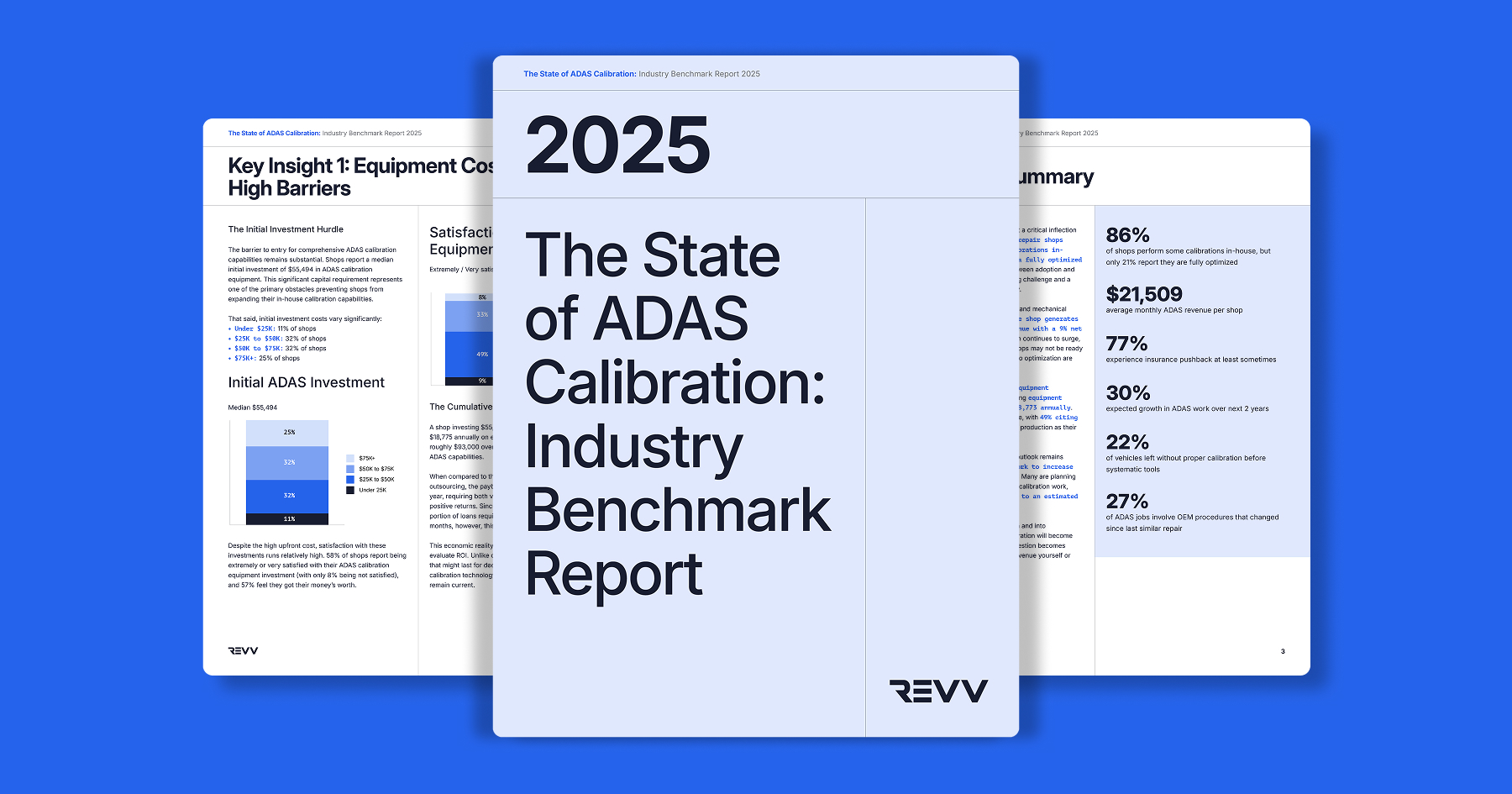
Our latest benchmark study of 300 auto repair shops reveals a striking reality: While 86% of shops now perform at least some ADAS calibrations in-house, only 21% report having a fully optimized calibration process.
And the data shows that the gap between adoption and optimization is where most shops are often losing money, turning away work, and missing revenue opportunities they don't even know exist.
We surveyed collision shops, mechanical repair facilities, and auto glass providers across North America to understand how they're really handling ADAS calibration. Here are five insights that might surprise you.
1. Most shops don’t actually know what “optimized looks like”
78% of shops have established a dedicated space for ADAS calibrations. Many have invested $55,000+ in equipment. Shops are generating $21,509 in monthly ADAS revenue on average, with solid 9% net profit margins. By all external measures, they should be optimized.
Yet only 21% actually report having achieved full ADAS optimization.
What this means
Most shops have normalized inefficiencies they don't recognize as problems. They're performing calibrations, but they're doing it inefficiently—spending too much time hunting for procedures across multiple platforms, managing equipment updates and compatibility issues, or struggling with documentation requirements they haven't systematized.
Part of the problem is that shops exist along a maturity curve from complete outsourcing to becoming regional calibration hubs. Many have made mid-stage investments (including dedicated space, equipment, and trained technicians) without building mid-stage processes (think systematic identification, consolidated documentation, and efficient workflows). They're paying Stage 3 costs while still operating with Stage 2 processes. That is the absolute worst of both worlds.
The shops that recognize they're not optimized have a massive advantage. They can identify where they're losing money and fix it. The shops that think they're already optimized? They're leaving profit on the table without realizing it.
The real question isn't whether you're performing ADAS calibrations. It's whether you're performing them profitably.
2. The training paradox: 41 hours per year isn’t cutting it
Shops aren't skimping on training. The average facility reports that technicians complete 41 hours of ADAS-specific training per year, which is more than a full work week dedicated solely to ADAS education.
Yet when we asked what would make shops more likely to bring additional calibrations in-house, 59% identified "better technician training" as the key factor—the highest response among all options. Additionally, 36% cite training and technician expertise as a top operational challenge.
What this means
The problem isn't the quantity of training. It's that traditional classroom training doesn't match the messy reality of actual repair work.
Technicians told us they want:
- Real-world examples, not just theory ("show me how to handle calibration on a lifted truck")
- Just-in-time support when problems arise, not knowledge from training sessions months ago
- Practical troubleshooting guides for edge cases they actually encounter
Even more challenging, 27% of ADAS jobs involve OEM procedures that have changed since the last similar repair. Training becomes outdated faster than shops can keep technicians current through traditional programs.
Access to current, vehicle-specific guidance exactly when technicians need it solves this problem.
3. The fragmented documentation problem costs time and money
Even shops with the best ADAS calibration equipment and trained technicians are losing efficiency to fragmented information. When we asked how shops access OEM calibration procedures, the answers revealed a scattered landscape:
- 51% use equipment manufacturer software
- 44% maintain direct manufacturer subscriptions
- 40% rely on industry training materials
- 34% use third-party aggregation platforms
- 27% get procedures from sublet calibration providers
- 26% depend on word-of-mouth and experience
Technicians are constantly switching between platforms to find the information they need. With 27% of ADAS jobs involving procedures that have changed since the last similar repair, they can't rely on memory or saved documentation—they must verify current requirements for every vehicle, every time.
According to feedback from shops using Revv, documentation and procedure verification can take around an hour when relying entirely on manual processes across multiple platforms. Shops using consolidated software reduced that time to three to five minutes.
What this means
When technicians spend an hour hunting for procedures instead of performing calibrations, the shop loses money. Multiply that across dozens of jobs per month, and the efficiency cost becomes substantial.
The shops solving this problem aren't working harder, but instead are consolidating fragmented information into a single, reliable source with ADAS tools like Revv. Among Revv users, 81% consider the platform critical or important to their operations specifically because it eliminates this platform-hopping inefficiency.
4. The equipment investment vs. payback period tension
Here's the financial reality shops face: The median initial equipment investment is $55,494, with ongoing equipment and tooling costs averaging $18,773 annually. Over three years, that's roughly $93,000 in cumulative investment to build comprehensive ADAS capabilities.
Meanwhile, shops require relatively short payback periods for new investments, typically six to 12 months for purchase approval.
The math isn’t mathing.
A shop investing $55K initially can't possibly recoup that investment in six months on ADAS work alone, especially when 57% of calibrations are currently performed in-house (with 43% still outsourced). This creates a tension that prevents many shops from expanding their capabilities even when the long-term ROI is solid.
Despite this tension, satisfaction with equipment investments runs relatively high. 58% of shops report being extremely or very satisfied with their ADAS calibration equipment (with only 8% not satisfied), and 57% feel they got their money's worth.
What this means
Shops understand that ADAS equipment is a long-term strategic investment, not a quick payback play. But the disconnect between required payback periods (12 months or less) and actual payback reality (two to three years) creates hesitation when it comes to expanding coverage.
The shops succeeding here are:
- Focusing on high-volume makes first (Ford, Honda, Toyota, Chevrolet) to maximize equipment utilization
- Choosing aftermarket systems that cover multiple manufacturers rather than buying OEM-specific tools immediately
- Building systematic processes that reduce the time per calibration, improving throughput and accelerating payback
5. The insurance documentation burden is practically standard operating procedure
77% of shops report having to provide additional information to insurers when submitting ADAS calibration claims. This isn't a “once in a while” occurrence, as for many shops, documentation requests have become standard operating procedure.
The impact shows up in operational challenges: 19% of shops cite insurance reimbursement processes as a leading challenge, while 15% specifically identify insurance documentation requirements as an obstacle.
This creates unbillable time spent justifying charges that should be routine:
- Breaking down charges into granular line items (52% use this tactic)
- Documenting and sharing pre-scan and post-scan results (46%)
- Hunting down and providing OEM procedure printouts (46%)
- Explaining specific OEM requirements for each vehicle (43%)
- Providing calibration certificates and completion documentation (36%)
None of this time is billable. It's pure overhead that erodes the 9% net profit margin shops are earning on ADAS work.
What this means
Given that insurance pay jobs represent an average of 33% of shops' revenue, and 40% of shops say insurance reimbursement influences their investment decisions "a lot," solving the documentation problem isn't just about getting paid faster. It's about having the confidence to invest in expanding ADAS capabilities in the first place.
The shops handling this best aren't fighting harder for reimbursement but building documentation into their standard workflow so it happens automatically:
- Systems that automatically capture and format scan results
- Software that generates OEM procedure references with every estimate
- Processes that create calibration certificates without manual effort
When documentation requests come (and they will), these shops have everything ready immediately. No scrambling, no unbillable time, no payment delays.
Download the full report
These five insights represent just a fraction of what we learned from surveying 300 auto repair facilities about their ADAS calibration operations.
The complete benchmark report includes:
- How shops are planning to shift from 57% to 64% in-house work over the next two years
- Why 30% expected growth in ADAS work creates winner-take-all dynamics
- Strategic recommendations for building always-on training support
- How to address the biggest concerns about rising costs and changing OEM standards
- Actionable steps to position your shop for growth in 2026
Download the complete State of ADAS Calibration: Industry Benchmark Report 2025 to access all the data and insights you need for 2026 and beyond.
.jpg)