
Table of Contents
Shops across the country are investing in ADAS calibration equipment, training technicians, and launching calibration services. Yet three months later, many find themselves uncertain whether they're making real progress or just spinning their wheels. The investment has been made, but questions linger about capture rates, the right balance between in-house and outsourced work, and how to successfully structure their ADAS programs.
This uncertainty reflects a common challenge across the collision repair industry: shops at different stages of ADAS maturity often don't know where they currently stand or what the next logical step should be for their specific business.
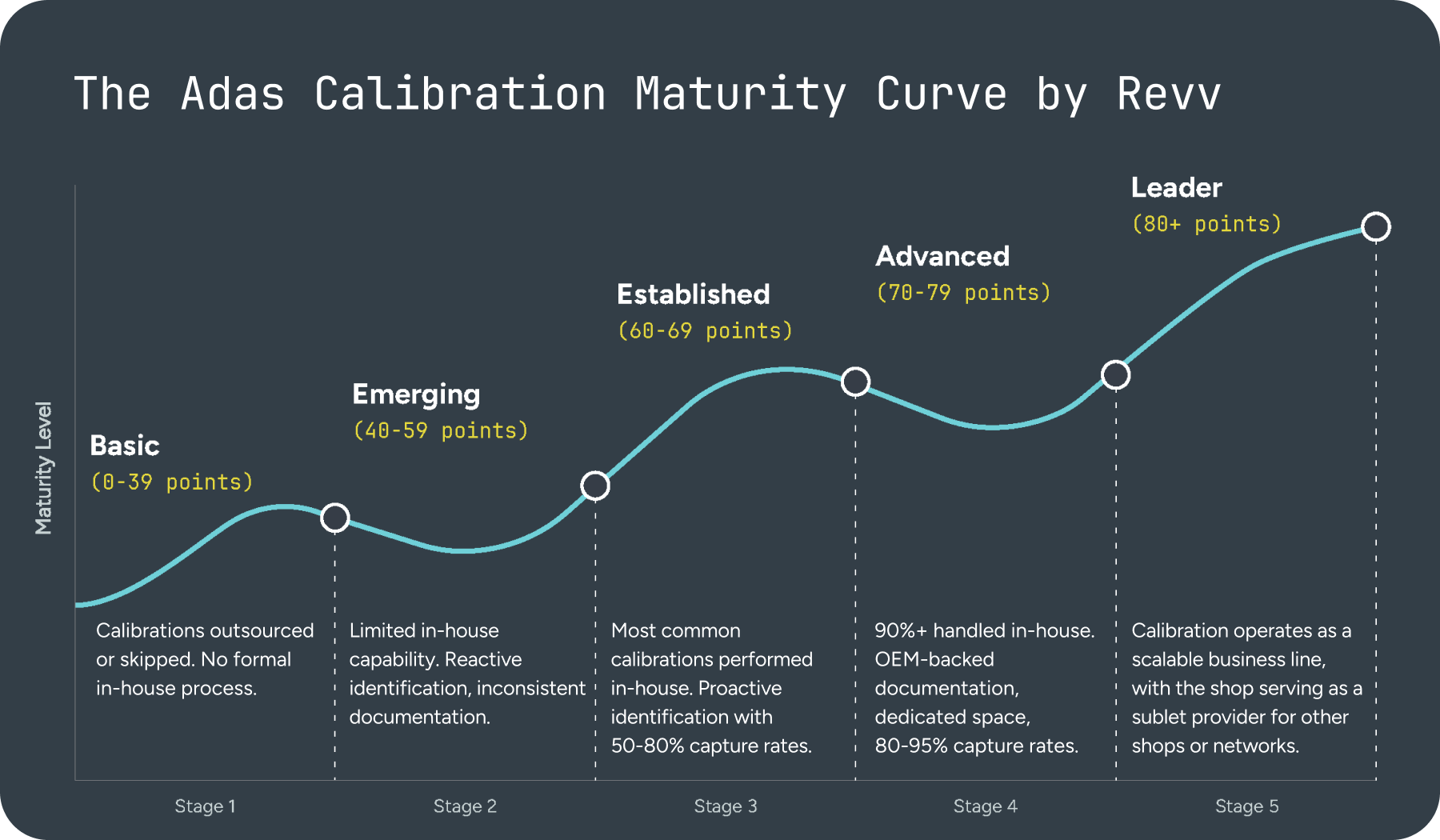
To address this Revv has created an ADAS Calibration Maturity Curve that provides a framework for understanding your shop's current capabilities and identifying the investments and process improvements needed to advance to the next level.
Instead of comparing yourself to an idealized "perfect" operation, this model recognizes that there are multiple stages of ADAS capability, and each has different resource requirements, revenue potential, and strategic purposes.
How the maturity curve works
We talked with approximately 300 shops nationwide including collision/body shops (59%) and mechanical repair shops (33%), as well as auto glass and calibration providers.
Respondents answered a series of questions across five categories: calibration capability, documentation and compliance, tooling and equipment, workflow integration, and revenue capture.
Answers map to a score out of 90 possible points, which places the shop into one of five levels: basic, emerging, established, advanced, or leader.
How the maturity curve can provide clarity
Not every shop needs to operate at the highest level of ADAS maturity.
A small shop in a rural market may find that Stage 2 capabilities meet their needs perfectly, while a large MSO location in a metropolitan area might need Stage 4 operations to remain competitive.
Understanding where you currently sit helps you make informed decisions about resource allocation. Should you invest in additional equipment or focus on improving processes with what you already have? Is it time to hire dedicated ADAS staff or can you continue cross-training body technicians?
The maturity curve provides a roadmap for growth that aligns with your business model. Rather than making uninformed investments, you can identify the specific gaps between your current stage and the next level, then prioritize improvements based on your market opportunity and strategic goals.
Each stage represents different revenue potential and cost structures. Shops stuck between stages often experience higher costs without corresponding revenue increases. Understanding the maturity curve helps you understand what measures to take that will actually deliver positive results.
Stage 1: Outsourcing and reactive response
At this foundational stage, calibration is entirely outsourced or skipped, with no in-house capability or formal process in place. Shops at this level rely on minimal diagnostic tools, have no dedicated calibration targets or space, and only respond to OEM requirements after issues arise or when insurers push back on repair approvals.
Stage 1 shops handle calibrations reactively. They’ll wait until a repair is denied or a customer complaint surfaces before addressing ADAS requirements. Documentation is minimal or non-existent, and there's often confusion about which vehicles require calibration after specific repairs.
Many shops operate at this level as a strategic choice rather than lack of awareness. In markets with limited ADAS-equipped vehicles or where mobile calibration services are readily available and affordable, outsourcing may be the most cost-effective approach.
However, Stage 1 shops face increasing challenges as ADAS penetration grows. Dependence on mobile providers can create scheduling bottlenecks that extend cycle times, while lack of in-house knowledge makes it difficult to identify required calibrations during estimating, leading to costly supplements and customer delays.
Moving from Stage 1 to Stage 2
Advancing to Stage 2 requires minimal capital investment, but demands process changes and knowledge development. Start by acquiring at least one ADAS-capable scan tool that can perform pre-scan and post-scan diagnostics—several entry-level platforms can handle basic diagnostic work on common vehicle makes.
- Developing a system for identifying when calibrations are required. This might start as simple reference guides for your most common vehicles and repair types, documenting which procedures trigger calibration requirements based on OEM position statements.
- Establish a relationship with a reliable mobile calibration partner who can serve as both a sublet provider and training resource. Many mobile providers will demonstrate procedures on-site, helping your team build knowledge while still outsourcing the actual work.
- Begin documenting ADAS-related work in your management system, even if you're outsourcing it. Track which vehicles required calibrations, what was performed, and what it cost. This data becomes essential for making informed decisions about bringing work in-house.
Stage 2: Limited in-house capability
Stage 2 shops perform limited calibrations using either mobile partners or basic in-house tools, typically focusing on simpler systems like forward-facing cameras. Some standard operating procedures exist, but documentation remains largely manual and inconsistent.
These shops own at least one calibration-capable scan tool and may have purchased basic targets, though they lack dedicated space for calibration work. Calibrations are still identified somewhat reactively, often based on visible damage to ADAS components rather than systematic VIN-specific analysis.
The transition into Stage 2 often happens organically as shops realize they're frequently outsourcing the same types of calibrations. Bringing common procedures in-house reduces dependency on mobile providers and improves cycle time for routine work.
However, Stage 2 shops often struggle with inconsistent processes. Technicians may handle the same calibration differently, documentation quality varies, and there's uncertainty about which calibrations should be done in-house versus outsourced.
Moving from Stage 2 to Stage 3
The jump from Stage 2 to Stage 3 represents the most significant transformation—moving from ad-hoc capabilities to systematic processes that reliably capture and monetize calibration work.
This advancement requires investment in both equipment and process infrastructure. You need comprehensive static calibration targets covering your most common vehicle makes, reliable ADAS-capable diagnostic platforms, and a designated space for calibration work even if it’s not yet a dedicated bay.
- Process improvements become critical at this stage. Implement software or systematic workflows for documenting calibration procedures, capturing labor time, and invoicing calibration work properly.
- Shift from reactive to proactive calibration identification by implementing VIN-specific ADAS decoding in your estimating process. This means researching vehicle configurations during initial estimates rather than discovering calibration requirements during disassembly.
- Develop formal training programs ensuring multiple technicians can perform common calibrations. This reduces bottlenecks and ensures consistent quality regardless of who performs the work.
Stage 3: Competent in-house operation
Stage 3 represents competent, sustainable ADAS operations. Shops at this level perform most common static and dynamic calibrations in-house and use software to document and invoice calibration work with some minor insurer pushback on less common procedures.
These shops own comprehensive ADAS-capable scan tools and target sets, with shared but allocated space for calibrations. Calibrations are increasingly identified proactively through VIN-specific research integrated into estimates, resulting in capture rates of 50-80% and a growing, identifiable calibration revenue line.
The key differentiator at Stage 3 is systematic process execution. Calibrations aren't captured sporadically, but through consistent workflows that identify requirements during estimating, allocate appropriate time and resources during repair planning, and document work properly for invoicing and compliance.
Stage 3 shops have achieved profitability on their ADAS operations. This means equipment investments are typically generating positive returns, and calibration work contributes meaningfully to overall shop profitability.
Moving from Stage 3 to Stage 4
Advancing to Stage 4 requires optimizing both physical infrastructure and operational processes to maximize capture rate and margin per calibration.
Physical improvements center on creating dedicated calibration space with proper environmental controls, including a bay specifically designated for ADAS work with controlled lighting, alignment rack capability, and organized storage for full target sets across multiple manufacturers.
- Operational optimization involves implementing VIN-specific ADAS decoding. This software should use automated estimate logic that identifies all required calibrations and properly codes them for insurer approval. This reduces supplement rates and increases first-time capture.
- Develop OEM-backed documentation processes. These processes should integrate manufacturer procedures directly into work orders and quality checks, creating audit-ready records that satisfy insurer requirements and reduce claim disputes.
- Track calibration performance metrics systematically. These metrics should include capture rate by vehicle type, average revenue per calibration, margin by procedure type, and cycle time impact. Use this data to identify where processes can be streamlined or where additional training or equipment would improve profitability.
Stage 4: Advanced optimization
Stage 4 shops perform over 90% of calibrations in-house, including complex multi-sensor systems such as blind spot monitoring and radar. OEM-backed documentation is fully integrated into estimates and audit-ready, with VIN-specific ADAS decoding and automated estimate logic achieving capture rates of 80-95%.
These shops maintain dedicated static and dynamic calibration bays with alignment racks, controlled lighting, and complete target sets. They've achieved clearly defined ROI by calibration type and can demonstrate profitability across their ADAS service mix.
The hallmark of Stage 4 operations is optimization. These shops have refined their processes to maximize efficiency and margin, while maintaining quality and compliance. Equipment utilization is high, technician productivity is strong, and insurer pushback is minimal due to comprehensive documentation.
Moving from Stage 4 to Stage 5
The transition to Stage 5 represents a strategic shift—moving from internal optimization to external service provision. This requires not just operational excellence, but also business model transformation.
- Consider whether serving as a calibration sublet provider aligns with your overall business strategy. Market calibration services to other shops, develop pricing structures for wholesale work, and manage scheduling for external customers.
- Standardize capabilities and processes to the point where they could be replicated across multiple locations. This requires documented SOPs, mature liability management processes, and quality systems that work independently of specific individuals.
- Invest in advanced infrastructure. Examples include multi-bay calibration facilities with sophisticated environmental controls, AI-enabled camera systems, and automated target positioning that enables higher throughput and consistency.
Stage 5: Market leader and service provider
Stage 5 shops operate calibration as a scalable business line, serving as sublet providers for other shops or collision networks. Capabilities and processes are fully standardized across locations, supported by mature liability management SOPs and minimal insurer denials.
These facilities feature multi-bay calibration operations with advanced environmental controls, AI-enabled cameras, and robotic target positioning that enables fully automated research, technician workflows, and documentation. Vehicle-specific SOPs are generated automatically, resulting in complete monetization of calibration work and meaningful external service revenue.
At this level, calibration operations function as a distinct business unit with its own P&L, customer base, and growth trajectory.
What the data tells us about the industry
42% of shops surveyed are either fully outsourcing calibrations or operating with limited, reactive capability. In an environment where 65% of repairs now require at least one ADAS recalibration, that gap between market demand and shop readiness is both a liability risk and a missed revenue line.
Here's how those 300 shops distributed across the curve:
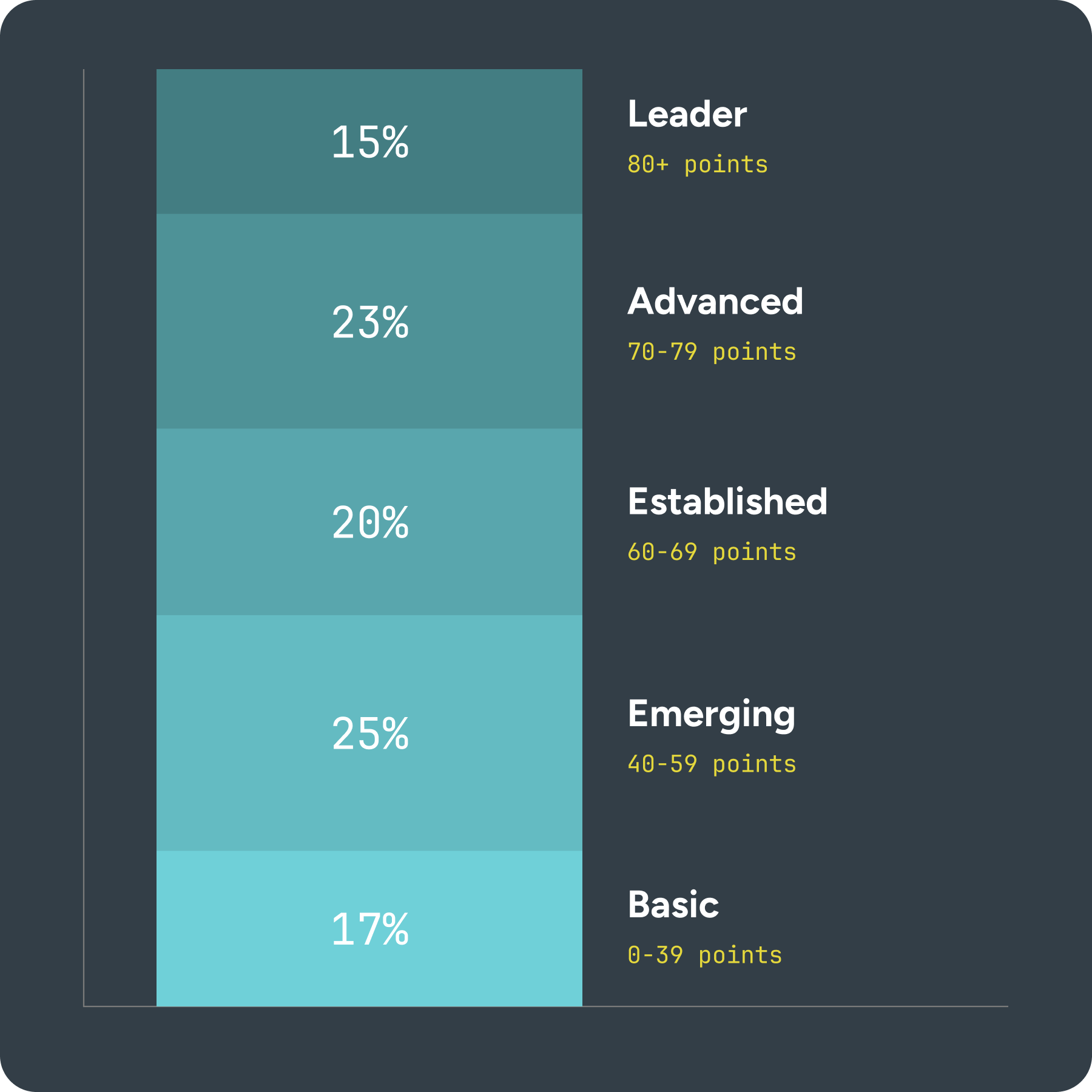
One in four shops sits at Emerging. These shops have made equipment investments and started bringing work in-house, but they haven't built the systematic processes needed to consistently capture and monetize that work. They own some tools and perform some calibrations, but ut without proactive identification, consistent documentation, and workflow integration, they're leaving money on the table every day.
The middle of the curve is where the biggest opportunity lives.
The 20% at Established are generating calibration revenue, but haven't optimized capture rates or fully resolved insurer documentation challenges. For many of these shops, the distance to Advanced is workflow optimization and better tooling versus major capital investment.
And the 38% at Advanced and Leader prove the model works. These shops have built repeatable systems that produce consistent revenue and minimal insurer friction.
Revv can help close the gap, no matter what stage you’re at
Revv helps shops close the gaps specific to their level, from automated calibration identification for shops moving out of Emerging, to integrated documentation and estimate logic for Established shops pushing toward Advanced.
Take the assessment to find out where you stand.
Book a demo today to see how Revv can support your shop's position on the maturity curve and help you plan your path to the next level.
.jpg)